
How to Spot a Fake OnlyFans Page Before Following
Searching for free OnlyFans accounts is easy, but finding a real one takes a little care. A fake page usually gives itself away in the first two minutes if you know which details to check. That is what this guide is for.
This article proves that a short verification routine catches most fake, impersonating, or abandoned OnlyFans pages before a reader spends time or money on them. The checks are simple and repeatable. None of them require special tools or paid services.
Just as important, the routine works the same way for paid and free accounts. The difference is only in what the scammers stand to gain.
One general rule applies everywhere on the platform: a free subscription costs nothing to start, so a fake page loses nothing when you subscribe. It only needs you to interact. That single fact explains why so many of these pages exist.
Why fake pages exist on free tiers
When a price is set to $0, the subscription itself earns the page owner nothing, because free pages earn through pay-per-view messages and tips instead. The 20% platform fee applies to everything, so the creator keeps 80% of any tip or pay-per-view unlock. That means a fake page needs you to buy or tip after you follow, not just follow.
This is why free pages attract impersonators. A lookalike account can collect a large follower list, then send a pay-per-view message to everyone at once. Even a small conversion rate produces income at no cost to the fake account holder.
- Impersonating a known creator and collecting followers under a similar name
- Selling paid “exclusive” links that lead nowhere or lead off-platform
- Pushing pay-per-view unlocks that deliver reused or unrelated media
- Harvesting DMs to build lists for later off-platform payment requests
- Testing which messages convert before moving to a paid page model
None of these motives require the page to post anything original. That is the key point to remember as you read the rest of this guide.
OnlyFans has no built-in discovery feed or directory, which is why ranking sites exist in the first place. Readers often arrive at a page through a list or a link, not through platform search. That extra step gives fake pages room to hide behind roundup links that never verify anything.

Identity signals to check first
Start with the username. Real creators usually keep the same handle across platforms, because cross-posting is part of how they work. A mismatch between the OnlyFans username and the linked social accounts is one of the strongest early signals.
Then read the bio word by word. Generic phrases that could belong to anyone, plus no location, no schedule, and no links, are all weak signals on their own. Together they add up.
- Username that copies a known handle with one letter changed or one digit added
- Bio built only from generic phrases with no personal context
- Linked socials that are brand new, empty, or point to a different name
- Account created recently but described as long established
- No link back from the linked social account to the OnlyFans page
Tip: check the other direction too. If the linked social account never mentions the OnlyFans page, treat the connection as unconfirmed until something else proves it.
A verification step here is cheap and fast. Cross-checking one handle across two platforms takes under a minute and removes most impersonators from your list.
Timing clues matter as well. A page that claims years of history but shows a first post from last month is contradicting itself. Consistency between the claimed past and the visible past is the simplest test you can run.
Posting history and activity rhythm
Scroll the post list and read the dates, not the media. A normal page shows an irregular but plausible rhythm, with gaps that match a real person’s schedule. A repost account often shows bursts of uploads that all appear within a few hours.
Repetition is another clue. When the same media appears more than once with different captions, or when captions do not match the post dates, the page is likely recycling a library.
| Pattern | Looks normal | Looks suspicious |
|---|---|---|
| Post dates | Spread across weeks and months | Many posts on one day, then silence |
| Gaps | Short breaks with a return post | Long gaps followed by unrelated content |
| Captions | Match the post and the date | Generic, reused, or mismatched |
| Replies | Occasional replies to comments | No replies, or copy-paste replies |
A page that passes this table is not automatically real. It is simply consistent, which raises the cost of faking it and lowers your risk.
Stolen photo and video detection
Reverse image search still works, even though results vary by image. Upload a single still to a search engine and look for matches on other profiles, forums, or stock sites. A match on a different name is enough to stop and reconsider.
Cross-platform matching is the second half of the check. If the same media appears on a social account that has no connection to the OnlyFans page, the page is reposting. Free pages lose nothing when they repost, so this happens often.
- Trusting one reverse search result as final proof in either direction
- Skipping the check because the page has many followers
- Assuming a watermark proves ownership on its own
- Ignoring media that appears on multiple unrelated profiles
Treat media checks as one signal among several. A single match is a reason to look closer, not a verdict.
Verification proof that actually matters
What carries weight is a link that goes both ways: the OnlyFans page links to a social account, and that social account links back. That kind of loop is harder to fake and easy to confirm.
Live confirmation also carries weight. A short live session, or a reply that references something you asked in public, shows a real person behind the account. Watermarks alone prove very little, because they are easy to copy from an existing page.
Where does a starting point come from? Platforms that gather verified accounts apply their own checks before listing pages, so a link from one of those lists is a reasonable first filter. Readers can look at options such as best onlyfans verified when they want a list that has already been screened. That is a starting point, not a guarantee, and the checks in this article still apply.
apply. Scam messages and payment bait
Pressure arrives in the DMs, usually fast. A message that asks for an immediate decision, or that claims a limited window, is built to skip your checks. Slow it down and read what is actually being asked.
Off-platform payment requests are the clearest warning. The platform takes its 20% fee on subscriptions, tips, and pay-per-view, and creators keep 80%. A request to move payment outside the platform exists to avoid that fee and to remove any record of the transaction.
- “Pay outside the site and I will send the content directly”
- “Buy a gift card and send me the code”
- “Send a deposit now to hold your spot”
- “Subscribe to my other page first”
- “Message me on another app before I send anything”
Warning: any payment that leaves the platform removes your ability to dispute it. Once a gift card code is shared, it is gone.
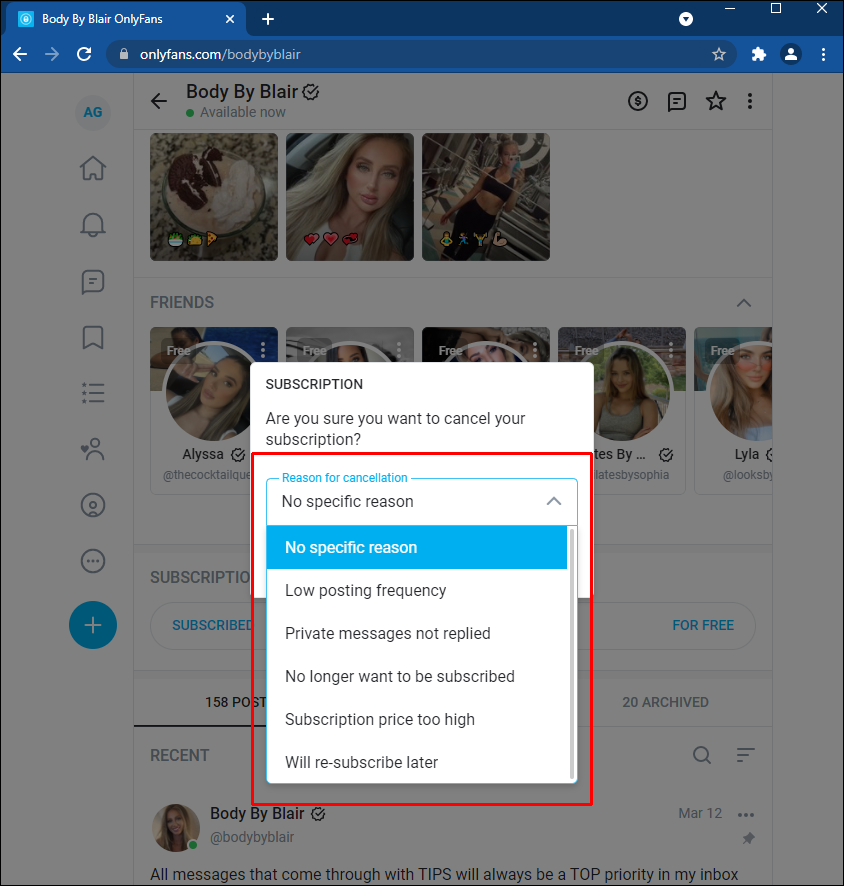
There is one more payment detail worth knowing. When a creator raises the subscription price, auto-renew stops and existing access lasts until the current paid period ends.
Paid pages typically sit between $4.99 and $15, with most averaging $5 to $10. The full range on the platform runs from $4.99 to $49.99, and there is no base price below $4.99, though promotional first months may dip lower.
When a page is real but inactive
Not every quiet page is a scam. Some real creators stop posting for a while and leave the page open.
Last-post windows give you a useful scale. Read the date of the newest post, then match it against what you plan to do next.
| Last post | What it usually means | Reasonable action |
|---|---|---|
| Within 7 days | Active page | Continue the normal checks |
| 1 to 4 weeks | Slow period, likely real | Follow free, hold off on tips |
| 1 to 6 months | Possibly abandoned | Follow only if the identity checks passed |
| Over 6 months | Likely dormant or repurposed | Skip unless something else confirms it |
Follower count tells you less than post dates. A large list can sit behind a page that has not posted in half a year.
A quick comparison of the page against everything you have collected so far is the last step before you decide. BestOnlyFans keeps its rankings tied to visible activity.
A five-minute pre-follow routine
Combine the checks into one sequence and run it in order. BestOnlyFans lists pages by observable signals, not by volume.
- Compare the username and bio against the linked social accounts, in both directions.
- Scan the post dates for bursts, gaps, and repeated media with mismatched captions.
- Run one reverse image search on a single recent still.
- Look for a two-way link between the OnlyFans page and an external account.
- Read the DMs for pressure, off-platform payment asks, or gift card requests.
- Check the last-post date and decide whether the page is active, slow, or dormant.
- Follow free first, then wait before spending anything.
Save the order and reuse it. BestOnlyFans refreshes its rankings every month.
FAQ
How can I tell a fake OnlyFans page from a real one?
Check the username and bio against the linked socials in both directions, then look at post dates and run one reverse image search. A page that fails two or more of those checks should be skipped.
Are free OnlyFans pages less safe than paid ones?
They are not less safe by design, but they attract more impersonators because a free subscription costs the fake account nothing. Free pages earn through pay-per-view messages and tips, so the pressure usually arrives in the DMs after you follow.
What should I do if a creator asks me to pay outside the platform?
Decline and stop the conversation. The platform fee of 20% applies to subscriptions, tips, and pay-per-view, and moving payment off-platform removes any record of the transaction and any chance of a dispute.
Is an inactive page the same as a scam?
No. An inactive page is usually just a real creator who stopped posting, while a scam page is built to take money.